Common Roots
WordPress nonprofit demo for a fictional community garden and food-security org — three programs in operational detail, impact-stats trust bar, four-tier donation page with per-tier impact, and a volunteer page that treats sign-up as a real conversation.
Overview
A WordPress marketing site for a fictional community garden and food-security nonprofit — five-page structure (Home, Mission, Programs, Donate, Volunteer) on a custom Full-Site-Editing block theme. Fifth and final demo in the Tier 1 batch; the last to ship without a new shared block.
Per-demo theme — warm/earthy, mission-driven palette:
- Thin child of the platform
_chassisparent - Forest moss primary (#3F6B3A), warm gold accent (#D9A23A), cream background (#F8F4E9)
- DM Sans throughout — same all-sans treatment as dental, but with the warmer palette the nonprofit register calls for
- Header carries the four-item nav plus a permanent "Donate" pill in gold (not the primary moss color — the inverted treatment gives the donate CTA the visual weight it needs to outrank the nav)
- Footer carries the 501(c)(3) bio + EIN + nav + office + contact
Tier 1 pattern: pricing-honesty across all five demos.
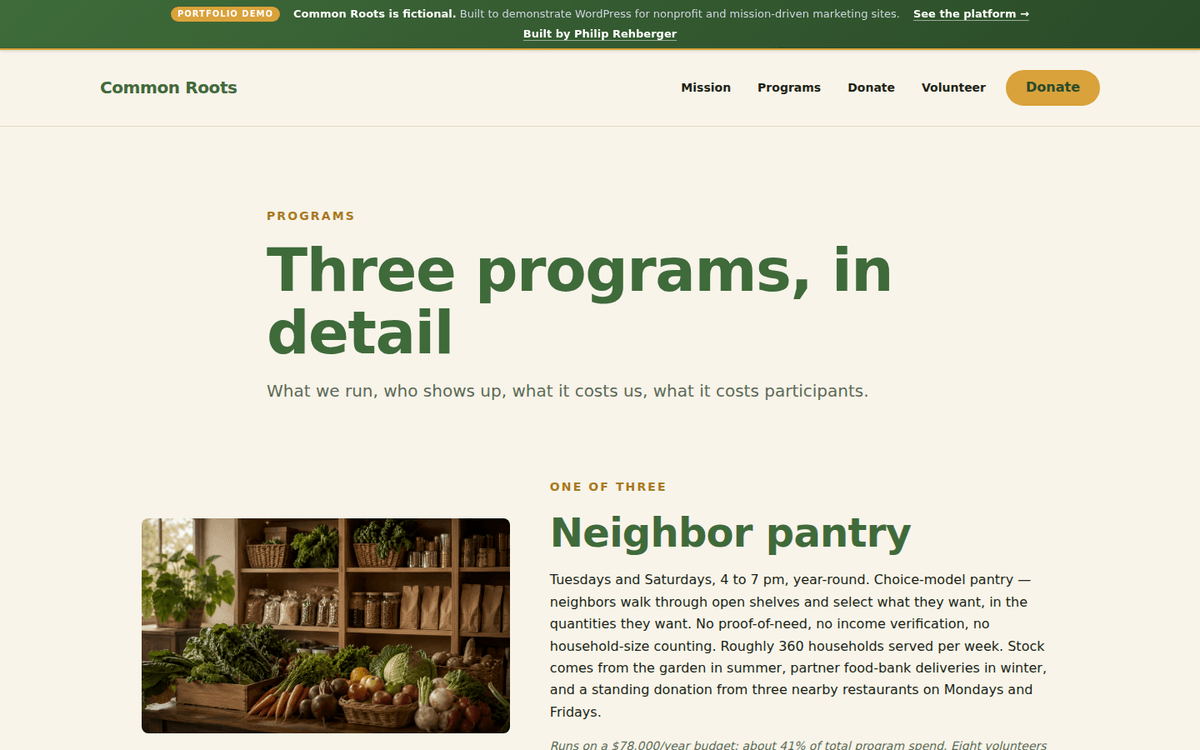
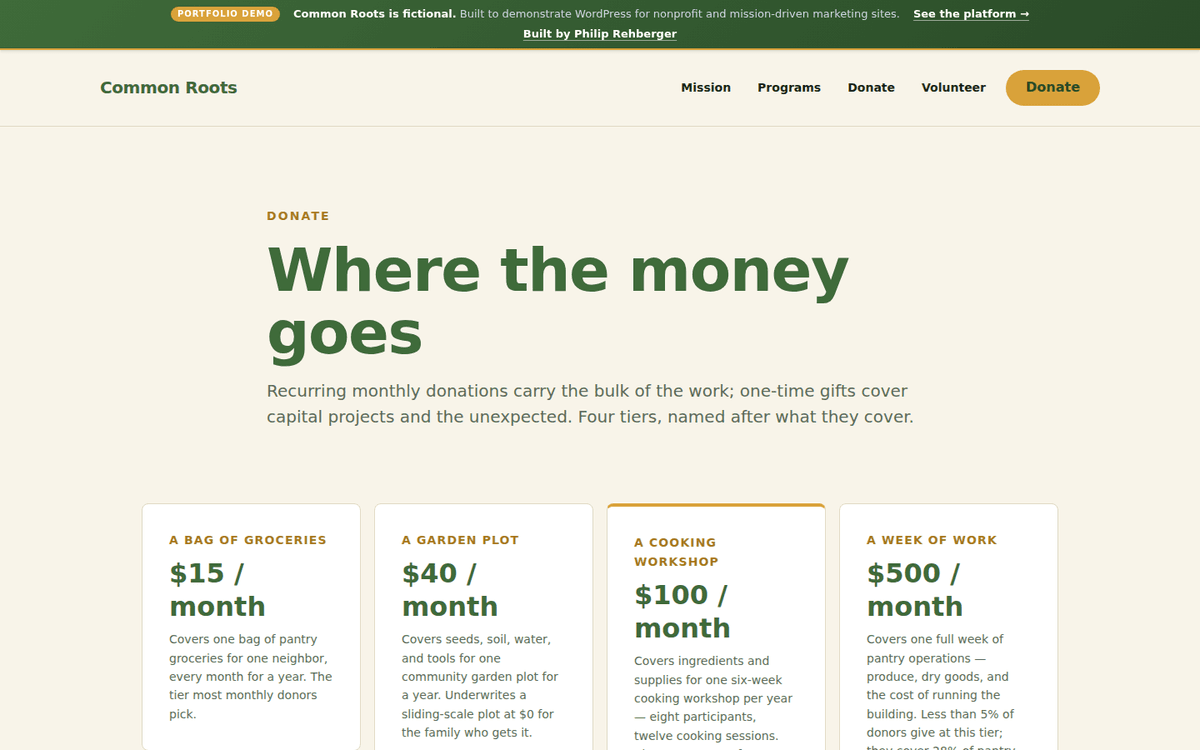
The Tier 1 discipline ran through legal representative-matter dollar figures, roofing cost ranges, dental procedure pricing, coaching engagement rates — and now nonprofit budget transparency. The Programs page shows the actual budget per program ($78,000/year for the pantry, $32,000/year for the garden, $24,000/year for nutrition education). The Donate page shows what each giving tier actually buys ("$15/month covers one bag of pantry groceries for one neighbor for a year"). The transparency is what separates a credible mission-driven site from the sentimentality-and-stock-photos default.
Five pages:
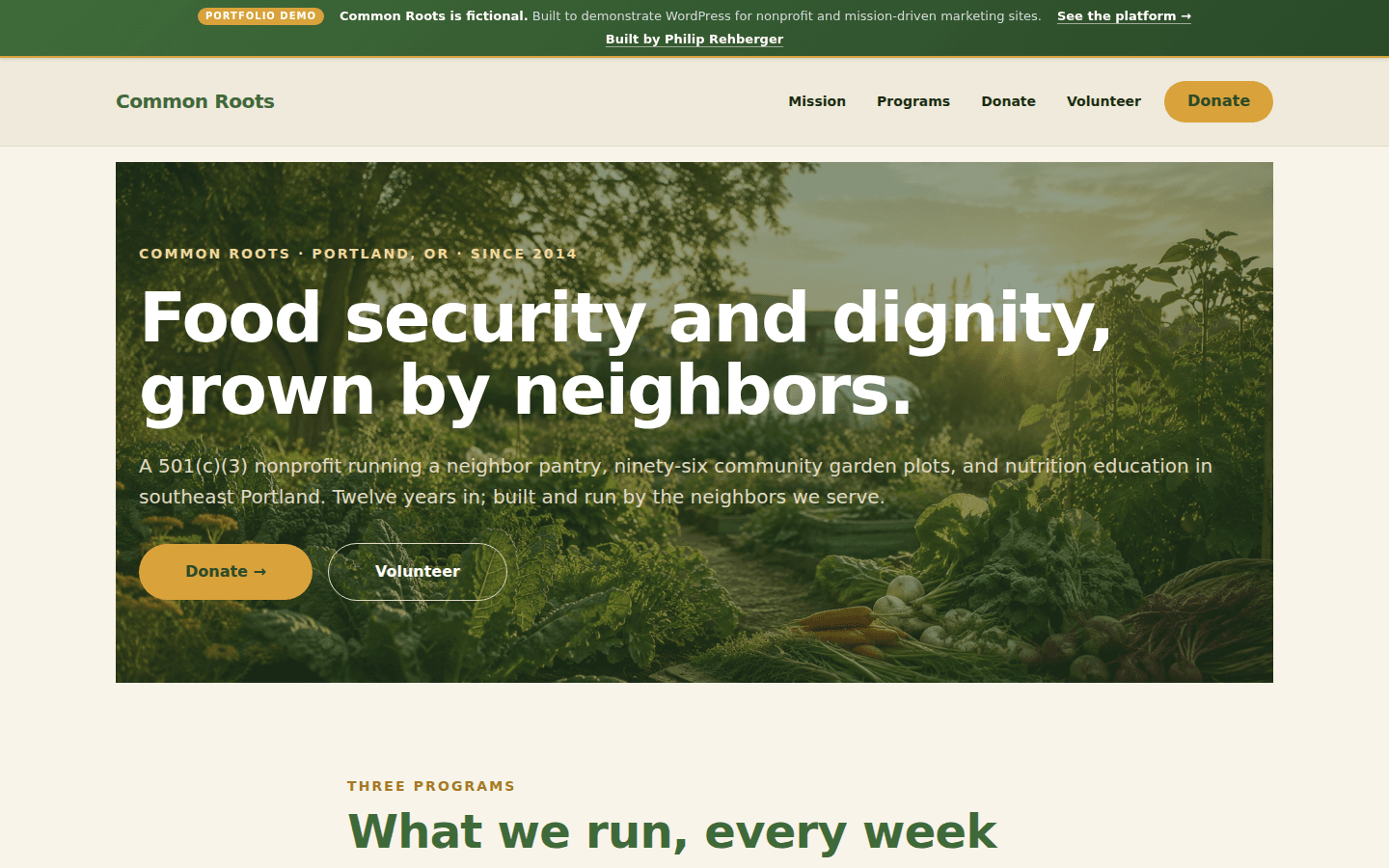
- Home — Moss cover hero with org name + tagline ("Food security and dignity, grown by neighbors."), three program cards, the
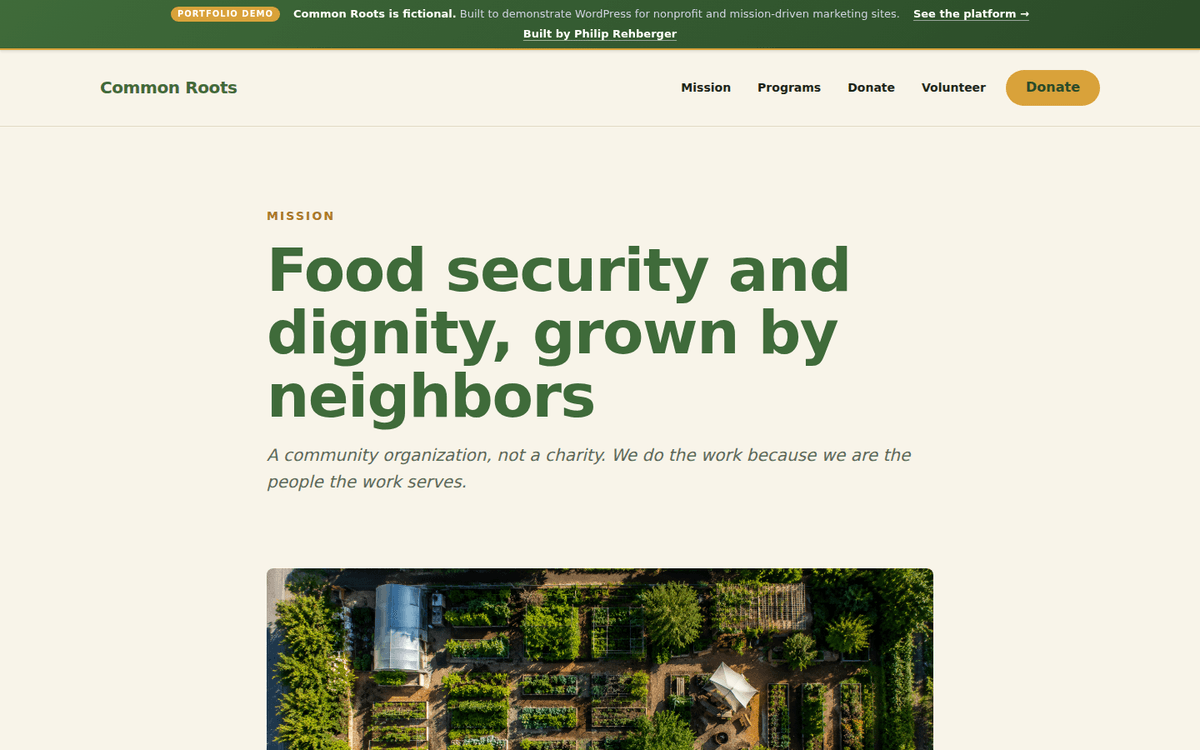
sfp-blocks/trust-stackimpact bar (12 years · 280,000+ meals · 96 garden plots · 18,000+ volunteer hours), and a "story of a Saturday harvest" callout that treats the impact narrative as concrete operational detail rather than donor-bait - /mission/ — Long-form mission across four H2 sections (How we started, Our theory of change, Who we serve, Staff & board) with the founder portrait + bio, the overhead garden shot, and a real-feeling theory-of-change paragraph that names the three things food insecurity is downstream of (income gap, transportation gap, knowledge gap) and is honest about which ones the org can address
- /programs/ — Three alternating image-text rows for Neighbor pantry, Community plots, and Nutrition education. Each row carries a substantive description and a per-program budget paragraph in italics
- /donate/ — Four giving tiers named after what they cover ("A bag of groceries / A garden plot / A cooking workshop / A week of work") with per-tier monthly amounts and concrete per-tier impact, plus a "how to give" callout that names all the channels (online via GiveLively, check, stock/IRA distributions, employer match) and the EIN
- /volunteer/ — Five regular shifts + two seasonal shifts named operationally (Pantry Tue/Sat, Garden Saturdays, Pickup driver Mon/Fri, Cooking workshop helper Wed, Office work flexible), a how-to-start three-step process, and a group-volunteering callout that names the corporate work-day pricing and explicitly says "no posed photo ops"
The Challenge
Nonprofits default to sentimentality-and-stock-photos sites — beneficiary photos with names withheld, vague impact stats ("over 100,000 people served!"), opaque budgets, and a donate page with sliding pricing that hides what each gift actually buys. The genre treats donors as marks rather than peers and beneficiaries as need-statistics rather than neighbors. The result is sites that read identically across thousands of mission orgs and tell prospective donors nothing actionable about what the work actually looks like.
The Solution
A per-demo theme on the platform chassis with no new shared block. Programs page with per-program budget transparency. Donate page with named tiers (a bag of groceries, a garden plot, a cooking workshop, a week of work) and per-tier monthly impact. Volunteer page with operationally specific shift names. Mission page with an honest theory of change that names what the org can and cannot address. Pricing-honesty discipline running through all five Tier 1 demos at this point — established as the platform-wide service-business norm.
Results
Lighthouse 98 / 96 / 100 / 92 (perf / a11y / best-practices / SEO) with placeholder photography — within a point of the platform ceiling without per-demo tuning
Five-page nonprofit site live in ~4 hours including per-demo theme, full seed with budget-transparent program content, hub case study, Project registration, and portfolio surfacing
No new shared block — fifth consecutive Tier 1 demo to make that call; the deferred person-card and before-after-slider stay queued for a real client engagement to drive the design
First demo with an inverted CTA treatment — gold donate pill against moss primary rather than the standard primary-on-base, giving the donate CTA the visual weight a nonprofit nav needs to outrank category navigation
Budget transparency on the Programs page completes the Tier 1 pricing-honesty arc across legal results, roofing cost ranges, dental procedure pricing, coaching engagement rates, and nonprofit program budgets. Five for five
Closes Tier 1: five demos live, all shipped with the per-demo-theme + no-new-block pattern, all in the 98–99 Lighthouse perf range without per-demo tuning. Twelve demos across the platform now, eleven consecutive since pulsar using the per-demo-theme split
Gallery